Complete Guide to Student Attendance Management for Indian Schools
Everything MSME schools need to know about attendance management in 2026. Covers manual vs digital systems, biometric alternatives, parent notifications, and CBSE compliance requirements.
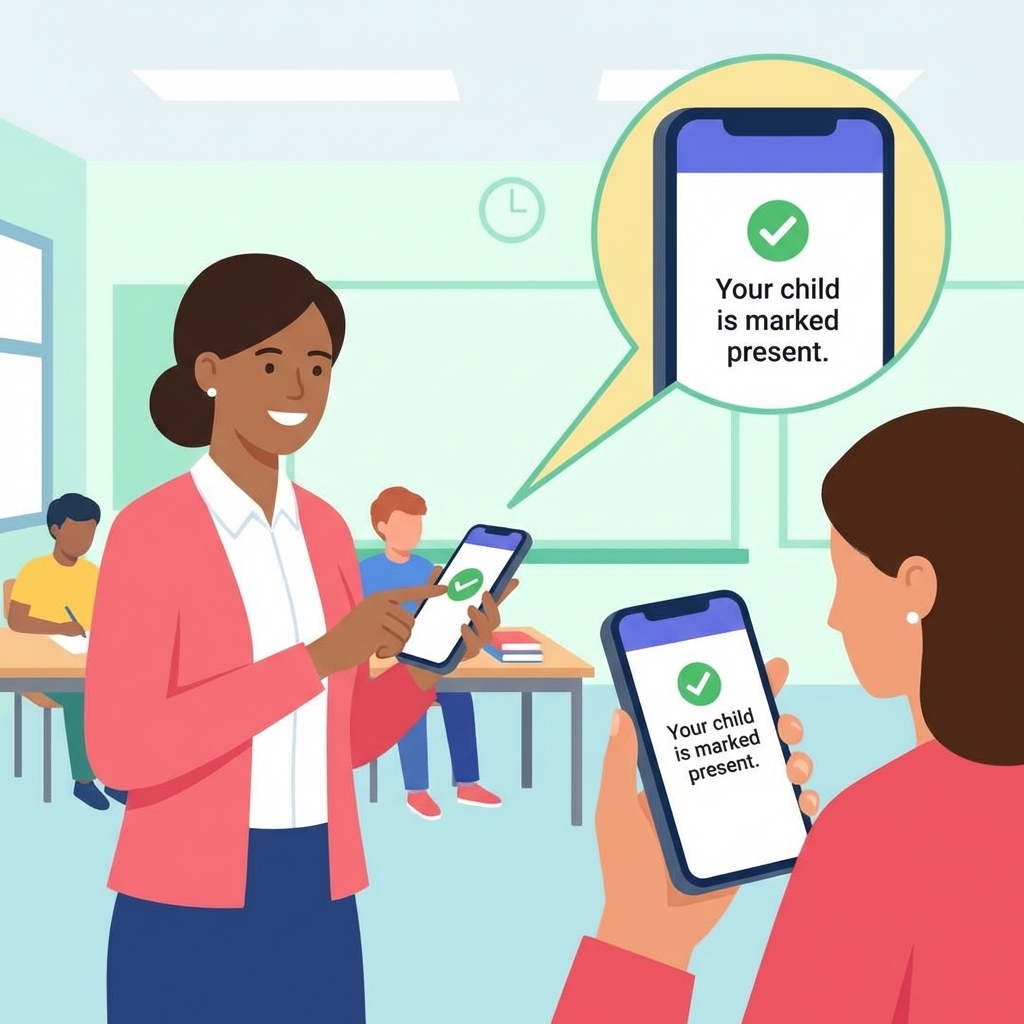
Attendance tracking consumes hours of teacher and administrative time daily—yet most schools still rely on paper registers and manual processes. A typical MSME school with 500 students spends 5-8 hours daily on attendance marking, register compilation, and absentee follow-up.
This comprehensive guide covers everything Indian schools need to know about modern attendance management, from choosing the right system to maximizing parent engagement through instant notifications.
What Is Student Attendance Management?
Student attendance management is the systematic process of recording, tracking, and reporting student presence in school. Modern attendance systems go beyond simple present/absent marking to include late arrivals, early departures, period-wise tracking, and automatic parent notifications. Effective attendance management directly impacts student learning outcomes—students with 90%+ attendance score 15-20% higher in exams according to NCERT studies.
Components of Attendance Management
| Component | Traditional Approach | Modern Digital Approach |
|---|---|---|
| Daily marking | Paper register per class | App-based tap marking |
| Consolidation | Manual compilation weekly | Real-time dashboard |
| Parent notification | None or monthly report | Instant SMS/WhatsApp |
| Reporting | Manual calculation | Auto-generated reports |
| Analysis | Rarely done | Trend analysis, alerts |
Why Does Attendance Tracking Matter for MSME Schools?
Accurate attendance tracking matters for three critical reasons: regulatory compliance (CBSE requires 75% minimum attendance for board exams), learning outcomes (regular attendance correlates with academic performance), and fee justification (parents paying ₹3,000+/month expect accountability for their child's presence). Schools with poor attendance tracking face compliance risks and parent complaints.
The Hidden Costs of Poor Attendance Management
Compliance Risk:
- CBSE mandates 75% attendance for board exam eligibility — see our CBSE affiliation requirements guide
- RTE Act requires schools to maintain attendance records
- Inspections check register accuracy
Learning Impact:
- Each day absent = 0.5-1% drop in annual scores
- Chronic absenteeism compounds over years
- Early intervention prevents dropout
Operational Burden:
- Teachers spend 10-15 minutes per class on roll call
- Admin compiles registers for hours weekly
- Manual errors cause disputes
Parent Relations:
- Parents unaware of child bunking
- Fee disputes without attendance proof
- Trust erosion over time
What Are the Different Types of Attendance Systems?
Indian schools use four primary attendance systems: paper registers (still 60% of MSME schools), Excel-based tracking (20%), app-based digital systems (15%), and biometric systems (5%). Each has trade-offs between cost, accuracy, and implementation complexity. For most MSME schools, app-based systems offer the best balance of affordability and effectiveness.
Attendance System Comparison
| System Type | Initial Cost | Monthly Cost | Accuracy | Parent Notification |
|---|---|---|---|---|
| Paper register | ₹500-1,000 | ₹200/month (paper) | 70-80% | Manual only |
| Excel tracking | ₹0 | Staff time | 80-85% | Manual email |
| App-based | ₹0-5,000 | ₹5-15/student | 95%+ | Instant automated |
| Biometric | ₹15,000-50,000/device | ₹2-5/student | 99%+ | Instant automated |
When to Choose Each System
Paper Register:
- Very small schools (under 100 students)
- Extremely limited budget
- No smartphone access for teachers
Excel Tracking:
- Transitioning from paper
- Schools with computer-literate staff
- Budget constraints but want some analytics
App-Based Digital:
- Most MSME schools (200-1000 students)
- Want parent notifications
- Limited budget for hardware
- Teachers have smartphones
Biometric:
- Large schools (1000+ students)
- Premium institutions
- Need foolproof accuracy
- Budget for hardware + maintenance
How Do App-Based Attendance Systems Work?
App-based attendance systems allow teachers to mark attendance using their smartphones in under 30 seconds per class. The teacher opens the app, selects their class, and taps to mark students present—absent students are auto-detected. Parents receive instant WhatsApp/SMS notifications for absences. All data syncs to a central dashboard for real-time visibility and reporting.
Teacher Workflow
Step 1: Open App (5 seconds) Teacher opens the attendance app on their smartphone and logs in (usually stays logged in).
Step 2: Select Class (3 seconds) Taps on their assigned class—system knows the period from timetable.
Step 3: Mark Attendance (10-20 seconds) Two marking methods:
- Default present: All students marked present, teacher taps to mark absent
- Individual marking: Teacher taps each present student
Step 4: Submit (2 seconds) Confirms and submits. System automatically:
- Records timestamp
- Sends absent alerts to parents
- Updates dashboard
Total time: 20-30 seconds vs 5-10 minutes with paper
What Parents See
When their child is marked absent, parents receive:
[School Name] Attendance Alert

Dear [Parent Name],

[Student Name] (Class [X], Section [Y]) was marked ABSENT today ([Date]).

If this is an error, please contact class teacher.

For leave application: [App Link]

- [School Name]
What Is the Best Attendance System for MSME Schools?
For most MSME schools with 200-800 students and limited budgets, app-based attendance integrated with school management software is the optimal choice. It eliminates hardware costs, works with teachers' existing smartphones, and provides instant parent notifications at ₹10-20 per student monthly—often bundled free with fee management software.
Why App-Based Beats Biometric for MSME Schools
| Factor | App-Based | Biometric |
|---|---|---|
| Initial cost | ₹0-5,000 | ₹50,000-2,00,000 |
| Hardware maintenance | None | Regular (dust, wear) |
| Queue time | None | 2-3 mins per student |
| Works during power cut | Yes (mobile data) | No |
| Teacher adoption | Easy | Doesn't involve teachers |
| Period-wise tracking | Yes | Difficult to implement |
| Parent notification | Instant | Instant |
When Biometric Makes Sense
- Schools with 1000+ students
- Premium institutions where parents expect it
- Security-sensitive environments
- Schools with history of proxy attendance
How Can Schools Implement Digital Attendance?
Implementing digital attendance requires four phases: preparation (teacher device audit, software selection), pilot testing (2-3 classes for 1 week), full rollout (all classes with parallel paper backup), and optimization (removing paper, refining process). Most schools complete implementation in 2-4 weeks.
Implementation Roadmap
Follow this roadmap alongside our 30-day school digitization guide for a comprehensive digital transformation.
Week 1: Preparation
- Audit teacher smartphone availability
- Select attendance system/software
- Create teacher accounts
- Prepare training materials
- Communicate to parents about upcoming change
Week 2: Pilot Testing
- Select 3-5 pilot classes (mix of grades)
- Train pilot teachers (30-minute session)
- Run digital attendance parallel to paper
- Gather feedback daily
- Fix issues before full rollout
Week 3: Full Rollout
- Train all teachers (grade-wise sessions)
- Enable digital attendance school-wide
- Keep paper backup for 1 week
- Monitor completion rates daily
- Address teacher questions immediately
Week 4: Optimization
- Remove paper registers
- Activate parent notifications
- Enable analytics dashboards
- Set up attendance reports
- Review and refine process
Common Implementation Challenges
Challenge 1: Teachers Without Smartphones
- Solution: School provides 1-2 shared devices per floor
- Alternative: Identify tablet-based or computer-based fallback
Challenge 2: Poor Internet Connectivity
- Solution: Use apps with offline sync capability
- Data syncs automatically when connection returns
Challenge 3: Teacher Resistance
- Solution: Demonstrate time savings (show 30 seconds vs 5 minutes)
- Involve resistant teachers in pilot to build ownership
Challenge 4: Forgetting to Mark
- Solution: Set automatic reminder notifications
- Admin dashboard shows unmarked classes in real-time
What Are CBSE Attendance Requirements?
CBSE mandates minimum 75% attendance for students to be eligible for board examinations (Classes 10 and 12). Schools must maintain accurate attendance records and can condone up to 25% absence in exceptional circumstances with proper documentation. CBSE inspections verify attendance register accuracy, making reliable tracking essential for affiliation compliance.
CBSE Attendance Rules Summary
| Requirement | Details |
|---|---|
| Minimum attendance | 75% of working days |
| Calculation basis | Total working days (not calendar days) |
| Condonation | Up to 25% absence can be condoned |
| Valid reasons | Medical (with certificate), NCC/Sports (school approved) |
| Documentation | Written records required |
| Board exam eligibility | Schools certify attendance compliance |
Attendance Shortage Handling
For Students Below 75%:
- Identify students with attendance issues early (monthly review)
- Send warning letter at 80% attendance
- Parent meeting at 78% attendance
- Document medical/valid reasons for condonation consideration
- Apply for condonation if valid grounds exist
- Inform students of board exam ineligibility risk if no improvement
How Should Schools Handle Student Absences?
Effective absence management involves immediate notification (same-day alert to parents), categorized tracking (medical, family emergency, bunking), follow-up protocol (call if absent 2+ consecutive days), and re-entry process (ensure parent is aware before student returns). This systematic approach catches issues early and demonstrates accountability to parents.
Absence Categories and Handling
| Absence Type | Immediate Action | Follow-Up Required |
|---|---|---|
| Single day (unexplained) | WhatsApp alert to parent | None if parent acknowledges |
| 2 consecutive days | Phone call to parent | Ensure awareness |
| 3+ consecutive days | Phone call + escalate to coordinator | Home visit if no response |
| Medical (with prior info) | Record in system | Medical certificate on return |
| Planned leave (informed) | Pre-approved in system | None |
| Chronic absenteeism (pattern) | Parent meeting | Intervention plan |
Sample Absence Follow-Up Protocol
Day 1:
- Automatic WhatsApp/SMS to parent
- No manual action required
Day 2:
- Second automatic notification
- Class teacher calls parent if no response to Day 1 alert
Day 3:
- Escalate to coordinator/counselor
- Parent must be contacted before student returns
Day 5+:
- Home visit by coordinator
- Meeting with principal on return
- Document for records
What Reports Should Schools Generate from Attendance Data?
Schools should generate five essential attendance reports: daily summary (for admin monitoring), weekly class-wise report (for teachers), monthly student-wise report (for parent communication), term-end analysis (for management review), and chronic absentee list (for intervention). These reports transform raw data into actionable insights.
Essential Attendance Reports
1. Daily Summary Report
- Total present/absent per class
- Unmarked classes (for follow-up)
- Late arrivals count
- Sent to admin by 10 AM daily
2. Weekly Class-Wise Report
- Attendance percentage per class
- Comparison to previous week
- Trend line (improving/declining)
- Used in staff meetings
3. Monthly Student-Wise Report
- Individual student attendance %
- Days absent with reasons
- Shareable with parents via app
- Triggers intervention at 85%
4. Term-End Analysis
- Class-wise average attendance
- Top attenders recognition
- At-risk students list
- Correlation with academic performance
5. Chronic Absentee Alert
- Students below 80% attendance
- Pattern analysis (which days missed)
- Contact log with parents
- Intervention status tracking
How Can Schools Improve Student Attendance?
Improving attendance requires addressing root causes: inconvenient school timing, health issues, family circumstances, disengagement, and bullying. Effective interventions include positive recognition (awards for 95%+ attendance), parent engagement (real-time notifications), early intervention (counselor involvement at 85%), and addressing disengagement (after-school activities, mentorship).
Proven Attendance Improvement Strategies
Strategy 1: Real-Time Parent Notifications
- Impact: 10-15% reduction in unexplained absences
- Why it works: Parents become aware immediately; children can't hide
- Implementation: Enable WhatsApp notifications on Day 1
Strategy 2: Positive Recognition
- Impact: 5-8% improvement in borderline students
- Why it works: Recognition motivates, creates peer pressure
- Implementation: Monthly attendance awards, certificates
Strategy 3: Early Intervention Meetings
- Impact: 20-30% improvement in chronic absentees
- Why it works: Addresses underlying issues before they compound
- Implementation: Mandatory parent meeting at 85% attendance
Strategy 4: Engaging After-School Activities
- Impact: 8-12% improvement overall
- Why it works: Students want to come when school is enjoyable
- Implementation: Sports, clubs, activities students look forward to
Strategy 5: Peer Accountability
- Impact: 5-10% improvement
- Why it works: Social pressure from classmates
- Implementation: Class attendance competitions, group recognition
What Are Common Attendance Tracking Mistakes?
The biggest attendance mistakes schools make are: inconsistent marking (some teachers mark, others skip), delayed parent notification (parents find out days later), ignoring patterns (not analyzing data), treating all absences equally (no categorization), and not involving parents (communication gap). These mistakes undermine the entire purpose of attendance management.
Top 10 Attendance Management Mistakes
| Mistake | Impact | Solution |
|---|---|---|
| Inconsistent marking | Unreliable data | Mandatory daily marking with reminders |
| Delayed notifications | Parents unaware of child bunking | Same-day automated alerts |
| No pattern analysis | Issues not caught early | Weekly review of at-risk students |
| Treating all absences equally | Can't prioritize intervention | Categorize by reason |
| Paper-only records | Errors, lost data, no analytics | Digital system with backup |
| No parent communication | Trust erosion | Monthly attendance reports to parents |
| Ignoring chronic absentees | Students slip through cracks | Automatic alerts below 85% |
| Not linking to academics | Missed correlation insights | Integrate attendance and marks data |
| Manual notification calls | Admin time wasted | Automated WhatsApp/SMS |
| No recognition system | No positive incentive | Attendance awards program |
How to Choose Attendance Management Software?
When selecting attendance software, prioritize: mobile app availability (teachers mark from phones), offline capability (works without internet), parent notification integration (WhatsApp preferred), report generation (automated, not manual), and integration with your existing school management system. Avoid standalone attendance apps—integration saves duplicate data entry. See our comparison of top 10 school management software for options that include attendance modules.
Attendance Software Feature Checklist
Must-Have:
- Mobile app for teachers (iOS and Android)
- Offline marking with auto-sync
- Parent notification (WhatsApp/SMS)
- Daily/weekly/monthly reports
- Class-wise and student-wise views
- Integration with school ERP
Nice-to-Have:
- Period-wise attendance (not just daily)
- Late arrival tracking
- Leave application through app
- Biometric integration option
- Custom notification templates
- Attendance analytics dashboard
Questions to Ask Vendors:
- Does the app work offline?
- Is WhatsApp integration included or extra?
- Can parents see attendance history?
- Are reports automated or do we create manually?
- How is student list updated when new admissions happen?
Frequently Asked Questions
How much time does digital attendance save?
Digital attendance saves 4-6 hours daily for a 500-student school. Teachers save 5-10 minutes per class (20+ classes = 100+ minutes), admin saves 2-3 hours on register compilation, and office staff saves 1-2 hours on parent calls about attendance queries.
Can parents submit leave applications through the app?
Yes, most modern school apps allow parents to submit leave applications digitally. Teachers/admin approve or reject, and the system automatically marks planned absences differently from unexplained ones.
What if a teacher forgets to mark attendance?
Good systems send automatic reminders to teachers who haven't marked by a set time (e.g., 10 AM). Admin dashboards show unmarked classes in real-time, allowing coordinators to follow up immediately.
Is biometric attendance better than app-based?
For MSME schools, app-based is typically better due to lower cost, no hardware maintenance, and period-wise tracking capability. Biometric makes sense for large schools (1000+ students) or those wanting foolproof accuracy.
How do we handle proxy attendance?
App-based systems prevent proxy by requiring teacher authentication and showing timestamps. Biometric prevents proxy completely. For app-based, periodic spot checks and pattern analysis catch anomalies.
What percentage of parents actually read attendance notifications?
WhatsApp notifications show 80-90% read rates within 2 hours. SMS shows 50-60% read rates. Email shows 20-30% read rates. This is why WhatsApp integration is critical for parent engagement.
Summary: Attendance Management Checklist
Quick Wins (Week 1)
- Audit current attendance accuracy
- Select digital attendance system
- Identify pilot classes and teachers
Implementation (Weeks 2-3)
- Train teachers on app
- Run pilot with 3-5 classes
- Enable parent notifications
Optimization (Month 1+)
- Generate weekly reports
- Set up chronic absentee alerts
- Implement recognition program
- Review and improve process
Ready to Transform Your Attendance Management?
ManabiApp makes attendance effortless for MSME schools:
- 30-Second Marking: Teachers tap to mark, absent alerts sent automatically
- WhatsApp Notifications: Parents actually read and respond
- Offline Sync: Works even without internet, syncs when connected
- CBSE Reports: Auto-generated attendance reports for compliance
- Integrated: Works with fee, marks, and report card modules
Start Your 14-Day Free Trial — See instant attendance improvement with parent notifications.
Or Book a Demo to see how schools like yours transformed attendance tracking.
Ready to Modernize Your School?
ManabiApp helps 500+ Indian schools save time, collect more fees, and keep parents happy. Start your free trial today.