NEP 2020 Compliance Checklist for Schools in 2026: Complete Guide
A comprehensive checklist for Indian schools to ensure full NEP 2020 compliance in 2026. Covers academic restructuring, competency-based assessments, infrastructure requirements, and digital readiness.
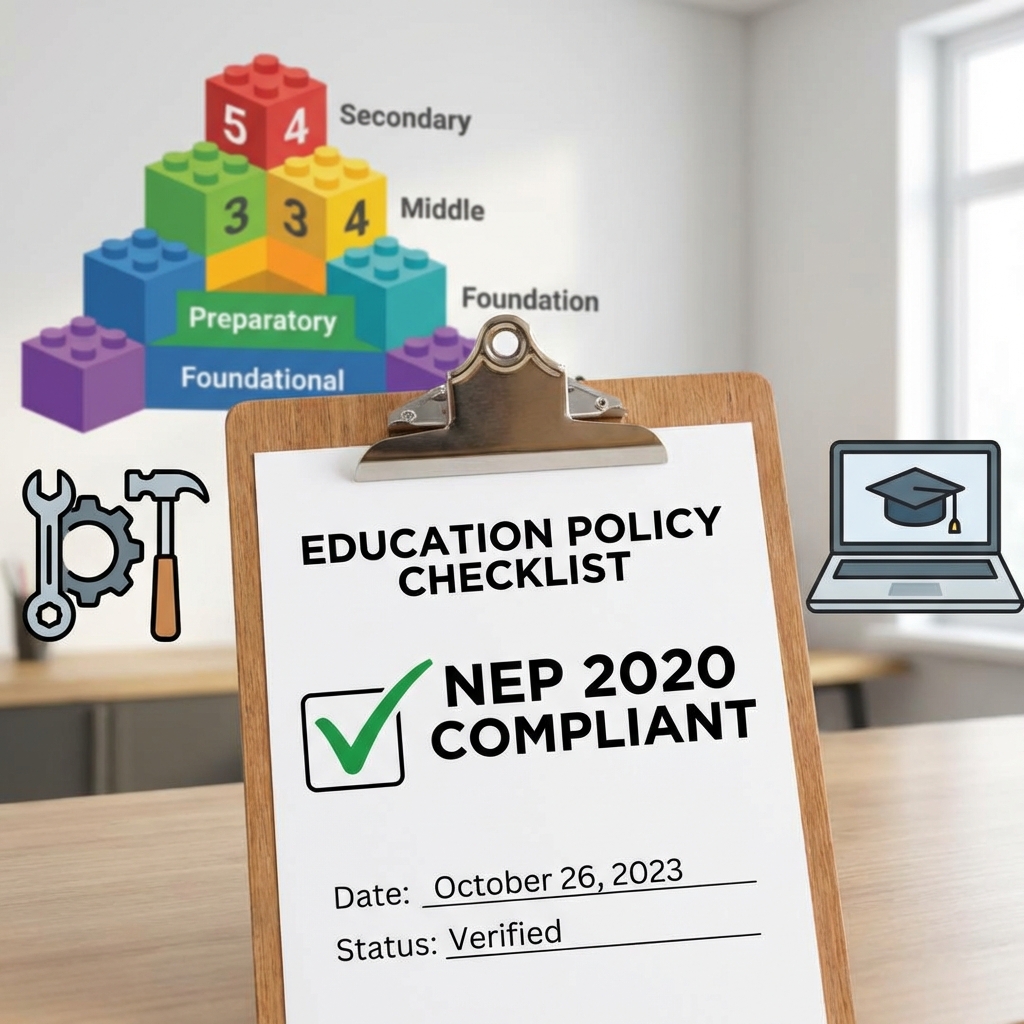
The National Education Policy 2020 represents India's most significant education reform in three decades, and 2026 marks a critical compliance deadline for schools across the country. With CBSE and state boards increasingly enforcing NEP guidelines, schools that haven't adapted risk affiliation issues and student enrollment challenges.
This comprehensive checklist covers every NEP 2020 requirement your school needs to address, organized by priority and implementation timeline. For CBSE schools, this works alongside the CBSE affiliation requirements you must also meet.
What Are the Key NEP 2020 Requirements for Schools in 2026?
NEP 2020 mandates schools to implement the 5+3+3+4 academic structure, competency-based assessments replacing rote learning, multi-disciplinary curriculum with no rigid stream divisions, and at least one vocational skill per student by Grade 8. Schools must also ensure 360-degree holistic progress cards, mother tongue instruction until Grade 5, and digital literacy as a core competency starting 2026.
The policy affects every aspect of school operations:
- Academic Structure: Shift from 10+2 to 5+3+3+4 (Foundational, Preparatory, Middle, Secondary)
- Assessment Method: Competency-based evaluation with reduced board exam weightage
- Curriculum Design: Flexible subject combinations, no arts/science/commerce divisions until Grade 11
- Teacher Training: Continuous professional development with 50 CPD hours annually
- Infrastructure: Smart classrooms, science labs, and vocational training facilities
What is the 5+3+3+4 Structure and How Should Schools Implement It?
The 5+3+3+4 structure divides school education into four stages: Foundational (ages 3-8, covering pre-school to Grade 2), Preparatory (ages 8-11, Grades 3-5), Middle (ages 11-14, Grades 6-8), and Secondary (ages 14-18, Grades 9-12). This replaces the traditional 10+2 system and requires schools to redesign curriculum, teaching methodology, and assessment patterns for each stage.
Implementation Checklist
| Stage | Age Group | Grades | Key Focus Areas |
|---|---|---|---|
| Foundational | 3-8 years | Pre-primary to Grade 2 | Play-based learning, mother tongue instruction, foundational literacy & numeracy |
| Preparatory | 8-11 years | Grades 3-5 | Subject introduction, experiential learning, local language continued |
| Middle | 11-14 years | Grades 6-8 | Subject exploration, vocational exposure, critical thinking |
| Secondary | 14-18 years | Grades 9-12 | Multi-disciplinary, depth + flexibility, board preparation |
Actions Required:
- Curriculum Mapping: Align existing syllabus to NEP stage-wise learning outcomes
- Teacher Retraining: Train teachers for age-appropriate pedagogy per stage
- Assessment Redesign: Create formative assessments aligned to each stage's competencies
- Report Card Update: Implement stage-specific holistic report cards
How Should Schools Implement Competency-Based Assessment?
Competency-based assessment evaluates what students can do with their knowledge rather than what they memorize. NEP 2020 requires schools to assess students on defined competencies across cognitive, affective, and psychomotor domains. Report cards must show competency levels (Beginning, Developing, Proficient, Advanced) rather than just marks, with at least 40% weightage to formative assessments by 2026.
Competency Assessment Framework
Cognitive Competencies:
- Critical thinking and problem-solving
- Information analysis and synthesis
- Application of concepts to real-world scenarios
Affective Competencies:
- Collaboration and teamwork
- Communication (written and verbal)
- Ethical reasoning and values
Psychomotor Competencies:
- Physical coordination and sports
- Hands-on skills and craft
- Digital literacy and technology use
Report Card Changes Required:
Your school's report cards must now include:
- Competency ratings (not just marks) for each subject
- Holistic progress indicators covering academics, sports, arts, and values
- Teacher observations in narrative format
- Self-assessment sections for students (Grades 6+)
- Learning goals for the next term
Pro Tip: Many school management software systems now offer NEP 2020 compliant report card templates. ManabiApp's report card module was specifically designed for competency-based reporting with customizable competency matrices.
What Infrastructure Upgrades Does NEP 2020 Require?
NEP 2020 mandates smart classroom infrastructure with digital learning capabilities, functional science and computer labs by Grade 6, dedicated spaces for art, music, and physical education, and vocational training facilities for at least one skill stream. Schools must also ensure accessibility compliance for students with disabilities, including ramps, accessible toilets, and assistive technology provisions.
Infrastructure Compliance Checklist
Digital Infrastructure:
- Smart classrooms or projector-equipped rooms (minimum 30% of classrooms)
- Computer lab with minimum 1:20 computer-to-student ratio
- Reliable internet connectivity (minimum 10 Mbps)
- Digital library access or e-learning platform subscription
- School management software for digital record-keeping
Physical Infrastructure:
- Science laboratories (Physics, Chemistry, Biology) for Grades 6+
- Multipurpose hall for assemblies and indoor activities
- Playground meeting CBSE norms (minimum area as per school strength)
- Dedicated art and music rooms
- Library with minimum books per student (CBSE: 3 books per student)
Accessibility Requirements:
- Ramps at all building entrances
- Accessible toilet on each floor
- Signage in Braille for visually impaired students
- Hearing loop or assistive devices for auditory support
- Resource room for students with special needs
What Are the Teacher Training Requirements Under NEP 2020?
NEP 2020 requires all teachers to complete 50 hours of Continuous Professional Development (CPD) annually, with training in competency-based pedagogy, technology integration, and inclusive education. By 2026, teachers must be trained in the National Professional Standards for Teachers (NPST), and schools must maintain documented training records for CBSE/state board inspections.
Mandatory Training Areas for 2026
-
Competency-Based Teaching Methods
- Designing learning outcomes aligned to competencies
- Creating rubrics for competency assessment
- Differentiating instruction for diverse learners
-
Technology Integration
- Using digital tools for classroom instruction
- Creating and curating digital content
- Online assessment and feedback methods
-
Inclusive Education
- Identifying and supporting students with learning differences
- Universal Design for Learning (UDL) principles
- Classroom accommodations and modifications
-
NEP-Specific Modules
- Understanding the 5+3+3+4 structure
- Implementing Foundational Literacy and Numeracy (FLN) mission
- Vocational education integration
Documentation Required:
Maintain records of:
- Training certificates for each teacher
- CPD hours log (50 hours minimum annually)
- Training attendance registers
- Post-training implementation reports
How Should Schools Handle Multi-Disciplinary Education and Stream Flexibility?
Under NEP 2020, the rigid separation of Arts, Science, and Commerce streams is abolished from Grade 11 onwards. Students can choose any combination of subjects regardless of traditional stream boundaries—for example, Physics with Economics and Psychology. Schools must enable flexible subject combinations, ensure timetable accommodation for cross-stream choices, and provide guidance counseling for students making these decisions.
Implementation Steps:
-
Subject Combination Framework:
- Create a master list of all subjects offered
- Define minimum and maximum subjects per student
- Identify mandatory subjects (languages, values education)
- Allow at least 5-6 elective slots for Grades 11-12
-
Timetable Restructuring:
- Use modular scheduling to accommodate varied combinations
- Consider block scheduling for practical subjects
- Enable overlap periods for common subjects
-
Counseling Setup:
- Train teachers as career counselors
- Conduct parent orientation on new flexibility
- Provide subject selection guidance sessions (Grade 10)
Important: Your school management software must support flexible subject-student mapping rather than rigid stream assignments. Legacy systems designed for traditional streams will struggle with NEP compliance.
What Are the Vocational Education Requirements?
NEP 2020 mandates that every student must be exposed to vocational skills starting from Grade 6 and complete at least one vocational course by Grade 8. Schools must partner with local industries or skill institutions to provide practical vocational training. By 2026, CBSE expects schools to offer a minimum of 2-3 vocational streams aligned with NSQF (National Skills Qualifications Framework) levels.
Vocational Streams for Schools
Popular Vocational Options:
- Information Technology and AI basics
- Retail and Entrepreneurship
- Healthcare and First Aid
- Agriculture and Food Processing
- Tourism and Hospitality
- Financial Literacy and Accounting
Compliance Requirements:
- Partnership agreements with skill training institutes or industries
- Dedicated vocational training hours in timetable (minimum 6 hours/week for Grade 8)
- NSQF-aligned curriculum for chosen streams
- Practical assessment components for vocational subjects
- Internship or exposure visits (minimum 2 per academic year)
What Technology Systems Do Schools Need for NEP 2020 Compliance?
Schools need integrated school management software that supports NEP 2020 requirements including competency-based report cards, flexible subject combinations, 5+3+3+4 stage management, and holistic progress tracking. The system must enable multi-dimensional assessment entry, generate CBSE-compliant transcripts, and maintain digital records for the Academic Bank of Credits when implemented.
Essential Digital Systems:
-
School Management Software (ERP):
- Student information management with stage-wise categorization
- Competency-based gradebook and report cards
- Flexible timetable management for multi-disciplinary offerings
- Parent portal for continuous communication
-
Learning Management System (LMS):
- Digital content delivery and assignment submission
- Online assessments with varied question types
- Student progress tracking across competencies
- Resource library and digital textbooks
-
Assessment Tools:
- Rubric-based grading capabilities
- Portfolio management for student work samples
- Formative assessment tracking
- 360-degree feedback collection
ManabiApp NEP 2020 Features:
ManabiApp was built specifically for Indian schools navigating NEP 2020 compliance:
- Competency Report Cards: Pre-built templates aligned to CBSE's competency framework
- Flexible Academics: Support for any subject combination without stream restrictions
- Holistic Progress Tracking: Track academics, sports, arts, and co-curricular in one dashboard
- Stage-Wise Management: Organize classes by NEP stages, not just grades
What is the Timeline for NEP 2020 Implementation?
The Ministry of Education has set 2025-2026 as the critical year for schools to achieve substantial NEP compliance. CBSE has already mandated competency-based assessments for Grades 1-8 from 2024, with Grades 9-12 following. Schools that fail to demonstrate compliance risk affiliation issues during inspection cycles, and new affiliations will require NEP readiness proof. See how 5 schools successfully transformed their operations including NEP 2020 compliance.
Key Milestones:
| Year | Requirement | Status |
|---|---|---|
| 2023-24 | FLN Mission implementation (Grades 1-3) | Completed |
| 2024-25 | Competency assessments for Grades 1-8 | Current |
| 2025-26 | Full 5+3+3+4 structure alignment | Due |
| 2025-26 | Vocational exposure mandatory by Grade 8 | Due |
| 2026-27 | Multi-disciplinary options for Grade 11 | Upcoming |
| 2030 | Academic Bank of Credits full implementation | Future |
Complete NEP 2020 Compliance Checklist for 2026
Use this checklist during your next staff meeting or board review:
Academic Structure
- 5+3+3+4 stage-wise curriculum mapping completed
- Learning outcomes defined for each stage
- Age-appropriate teaching methodologies implemented
- Mother tongue instruction available until Grade 5
Assessment & Reporting
- Competency-based assessments for all grades
- Holistic report cards with competency levels
- 40% minimum formative assessment weightage
- Student self-assessment components (Grades 6+)
Curriculum & Pedagogy
- Multi-disciplinary subject options for Grades 11-12
- No rigid stream divisions enforced
- Vocational exposure from Grade 6
- One vocational course completed by Grade 8
Teacher Development
- 50 CPD hours completed per teacher annually
- Training in competency-based teaching
- Technology integration training
- Inclusive education certification
Infrastructure
- Smart classroom infrastructure (30% minimum)
- Functional science and computer labs
- Accessibility compliance verified
- Vocational training facilities operational
Technology Systems
- NEP-compliant school management software
- Digital learning platform available
- Electronic records and report cards enabled
- Parent communication portal active
Next Steps for Your School
- Audit Current Status: Use this checklist to assess gaps
- Prioritize Actions: Focus on assessment and academic structure first
- Train Your Team: Invest in teacher CPD before other changes
- Upgrade Technology: Ensure your school software supports NEP requirements
- Communicate to Parents: Explain changes in report cards and academics
Need help with NEP 2020 compliance? ManabiApp's school management software is purpose-built for Indian schools implementing NEP 2020. Start your free trial or book a demo to see competency-based report cards in action.
Frequently Asked Questions
What is the 5+3+3+4 structure under NEP 2020?
The 5+3+3+4 structure divides school education into four stages: Foundational (ages 3-8, pre-school to Grade 2), Preparatory (ages 8-11, Grades 3-5), Middle (ages 11-14, Grades 6-8), and Secondary (ages 14-18, Grades 9-12). This replaces the traditional 10+2 system.
What is competency-based assessment under NEP 2020?
Competency-based assessment evaluates what students can do with their knowledge rather than what they memorize. Report cards must show competency levels (Beginning, Developing, Proficient, Advanced) rather than just marks, with at least 40% weightage to formative assessments.
What teacher training does NEP 2020 require?
NEP 2020 requires all teachers to complete 50 hours of Continuous Professional Development annually, with training in competency-based pedagogy, technology integration, and inclusive education. Schools must maintain documented training records for board inspections.
What vocational education requirements does NEP 2020 mandate?
Every student must be exposed to vocational skills from Grade 6 and complete at least one vocational course by Grade 8. Schools must partner with industries or skill institutions and offer minimum 2-3 vocational streams aligned with NSQF levels by 2026.
Ready to Modernize Your School?
ManabiApp helps 500+ Indian schools save time, collect more fees, and keep parents happy. Start your free trial today.